Verdict
The Haptic Inductive Trigger System is a genuine, measurable upgrade to how a click behaves, not a marketing gimmick — but getting the full benefit means relearning your click, and $179.99 is a real ask for a feature casual players won't notice.
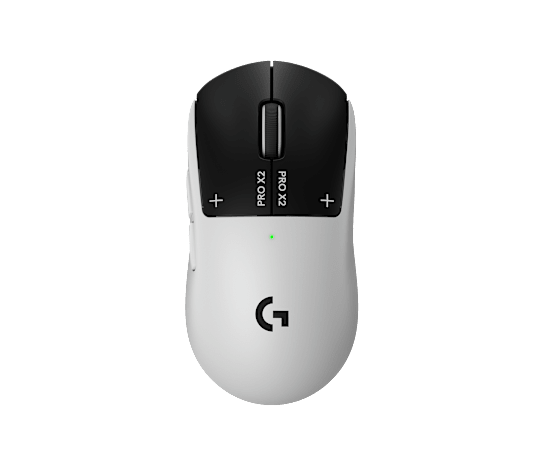
I've clicked a lot of mice in six years of doing this job, and most "next-gen input tech" pitches end the same way: a press release full of nanosecond claims, a shipping product that feels exactly like the one it replaced, and a review where I quietly move on. The Logitech G PRO X2 SUPERSTRIKE is the first mouse in a while that made me sit up mid-match and actually notice something was different under my finger.
That something is HITS — the Haptic Inductive Trigger System — and it's the entire reason this mouse exists. Everything else, the 61g Superlight 2 body, the 8,000Hz Lightspeed polling, the 90-odd hours of battery life, is Logitech doing what Logitech already does well. HITS is the swing.
The chassis is familiar, and that's the point
Strip away the electronics and the PRO X2 SUPERSTRIKE is built on the same Superlight 2 shape that's been the default competitive-mouse skeleton for a couple of years now: symmetrical, low-profile, 61g on my scale, with the shell perforated just enough to shave weight without turning the thing into a rattle-trap. If you've used a Superlight 2 or a G Pro X, your hand already knows this mouse. That's a deliberate choice — Logitech isn't asking you to relearn ergonomics, only the click.
Feet glide well out of the box, the side buttons and scroll wheel are unchanged and unremarkable in the best way, and Lightspeed wireless still just works — no perceptible latency, no dropouts through a full ranked session. None of this is new ground. It's the known-good foundation the actual pitch sits on top of.
Inside the click: what HITS actually changes
Traditional mouse buttons use a mechanical microswitch: press past a fixed point, get a binary signal. HITS replaces that on both main buttons with an inductive, electromagnetic sensing system — conceptually closer to the Hall-effect switches that reshaped gaming keyboards over the past couple of years than to any previous mouse click. Because the sensing is analog rather than binary, Logitech can expose the same tricks Hall-effect keyboards made popular: a fully adjustable actuation point, and a rapid-trigger mode that resets the instant you let off pressure instead of waiting for the switch to fully release.
Logitech pairs that with tunable haptic feedback, so the "snap" you feel isn't tied to a physical spring anymore — you can soften it, sharpen it, or push actuation down to a hair-trigger distance most mechanical switches can't approach. All of it lives in G HUB, per-button, and it's the first time I've spent real time in mouse software tuning something other than DPI and RGB.
Does it actually help, or is it a $180 gimmick?
This is the part that matters, and it's also where the coverage across the rest of the review circuit — TechRadar, PC Gamer, Gaming Nexus, RTINGS, Tom's Hardware — landed in a similar place to where I did: it's not a gimmick. Independent testing pegged the gains at roughly 8-9% faster response in pure reflex scenarios, 5-6% in tasks that combine tracking with clicking, and a meaningful jump in raw clicks-per-second with rapid trigger engaged — reviewers measured something like a 6-8% bump generally, and closer to 20% for deliberate butterfly/jitter-clicking techniques. Logitech's own number is up to 30ms shaved off click latency versus a conventional microswitch at the fastest settings.
The catch, and it's a real one: hitting that ceiling means running actuation at its absolute lowest point, which turns the button into something closer to a proximity sensor than a click. I had to consciously unlearn the habit of resting a pre-tensioned finger on the left button — a totally normal thing to do on any other mouse — because at the floor setting that pre-tension was enough to register as an input. It cost me a handful of embarrassing stray clicks in the first couple of sessions before I backed the actuation off slightly and found a setting that still felt meaningfully faster without punishing normal hand behavior. The 8,000Hz polling mode, by contrast, I'd file closer to genuine gimmick territory — it's there, it works, and almost nobody's reflexes or monitor will ever notice the difference from 1,000Hz.
Who it's for
If you play anything where clicks decide rounds — competitive shooters, mostly — and you're the type who already tunes sensitivity to the decimal, HITS is worth the learning curve and the price. If you're a strictly casual or single-player user, the $179.99 ask buys you a very good Superlight 2 with a party trick you'll rarely lean on; you'd be better served by a cheaper mouse in the same shape.
Verdict
The PRO X2 SUPERSTRIKE is the rare "revolutionary" gaming peripheral that actually changes the physical act of clicking, not just the marketing copy around it. HITS is a legitimate, testable improvement wrapped around one of the best mouse shapes on the market, and the tuning depth means you can dial it in rather than take Logitech's word for the fastest setting. It's not for everyone at this price, and the lowest-latency setting demands you retrain a habit you didn't know you had — but for the audience it's built for, this is the mouse to beat right now.
Score: 8.7/10
Pros
- HITS delivers a real, testable edge in click speed and rapid-trigger response, not just a marketing story
- Superlight 2 chassis at 61g is still one of the best shapes in gaming mice, now with a genuinely new trick
- Actuation point and haptic strength are independently tunable per button, down to a granular feel
- Battery life easily clears multi-day use even with high polling and haptics dialed up
Cons
- Chasing the lowest-latency setting means running actuation at its floor, which took real relearning and cost me a few stray clicks before it clicked (so to speak)
- $179.99 plus an 8,000Hz polling mode most players will never max out makes this a hard sell outside serious competitive play
- Software-dependent tuning means the mouse is only as good as the time you put into Logitech G HUB
The Haptic Inductive Trigger System is a genuine, measurable upgrade to how a click behaves, not a marketing gimmick — but getting the full benefit means relearning your click, and $179.99 is a real ask for a feature casual players won't notice.
See price →Some links in this article are affiliate links. If you buy through them, BlitzRig may earn a commission at no extra cost to you — see our advertising disclosure.