Verdict
The PG27AQDM is the 1440p/240Hz OLED that makes a 27-inch IPS panel feel obsolete for competitive and single-player play alike, held back only by dated HDMI ports and the usual OLED caveats.
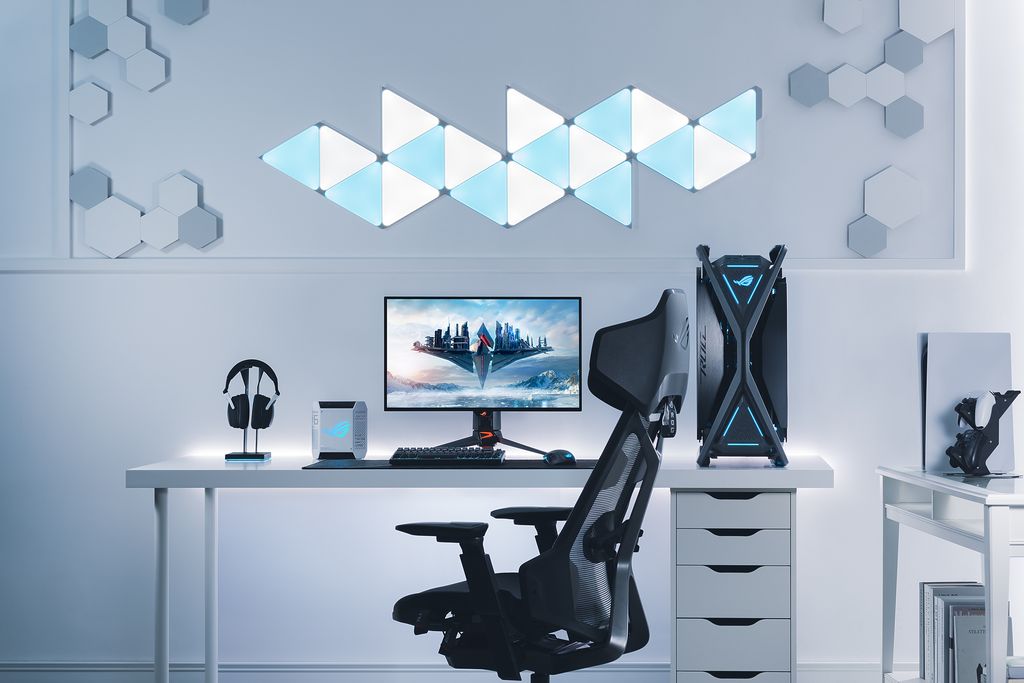
I've been rotating gaming monitors through my desk for close to a decade now, chasing the same thing every time: a panel fast enough that I stop noticing the screen and start noticing the game. IPS panels with fast VRR got close. Mini-LED got closer. But every one of them still had a tell — smearing in dark corners, blooming around a muzzle flash, a subtle softness to motion that 240Hz on paper never quite delivered in practice. I spent three weeks with the ASUS ROG Swift OLED PG27AQDM expecting another good-but-not-quite panel, and instead ran into the first monitor in years that made me stop thinking about the monitor at all — which is exactly the problem, because at this price, "it just works" isn't supposed to be a compliment you have to qualify.
First impressions: the PG27AQDM's familiar shape, unfamiliar panel
Pull the PG27AQDM out of the box and the ROG design language is instantly recognizable — matte black chassis, a thin RGB accent ring on the back, a stand that tilts, swivels, pivots and adjusts height without feeling like it's fighting you. None of that is new for ASUS — the same design language shows up on everything from the ROG Xbox Ally X to full towers. What's new is what's happening on the glass: a 26.5-inch QD-OLED panel at 2560x1440, running at 240Hz with a genuine 0.03ms response time. Samsung makes the panel, ASUS bolts a proprietary heatsink to the back of it, and the combination is the first real point of difference between this and the LG-panel OLEDs that have dominated the category for the past couple of years.
Setup took about ten minutes, most of it spent in the OSD turning off the demo mode and finding the "Uniform Brightness" toggle — more on that later. Build quality feels appropriately premium for a monitor that street-prices in the $700-900 range depending on the week and the retailer; I've seen it as low as $549 during sales and as high as $899 at full pop, so shop around before you buy.
The experience: this is what 240Hz was supposed to feel like
I ran the PG27AQDM through the same rotation I put every review unit through — competitive shooters, a fast racing sim, and a slower narrative game to test color and contrast rather than speed. In Counter-Strike and Apex, the difference from my previous 1440p IPS panel wasn't subtle. Motion stayed crisp through fast pans with none of the coronas or smearing I'm used to tuning around with overdrive settings. Response time here isn't a marketing number you have to squint to believe; you feel it in how cleanly a target holds its shape while you're tracking it.
Where the QD-OLED panel really separates itself, though, is color and contrast. Blacks are properly black — not "very dark gray" the way even good VA panels fake it, but the kind of black where a starfield in a space game just disappears into the bezel. ASUS's heatsink lets it hold roughly 450 nits in SDR and push near 1,000 nits in small HDR highlights, numbers that used to be unthinkable on OLED without cooking the panel. HDR content in Cyberpunk and a few Dolby Vision-mastered shows on the side looked genuinely punchy rather than the washed-out "HDR" a lot of gaming monitors still phone in.
The limits: connectivity and the usual OLED asterisks
Here's the part that keeps this from being an easy 9-plus: ASUS shipped this with one DisplayPort 1.4 and two HDMI 2.0 ports. No HDMI 2.1. On a monitor built around chasing frame rate, that's a real omission if you're also running it off a current-gen console — you'll be capped well below what the panel can do over HDMI. PC gamers plugging in over DisplayPort won't notice, but it's a strange corner to cut on a flagship.
Then there's the OLED conversation you can't avoid having. ASUS's Uniform Brightness setting keeps output consistent but caps peak brightness noticeably — leave it off and you get the higher numbers back, but full-white scenes (a bright website, a spreadsheet, a loading screen) will dim visibly as ABL kicks in to protect the panel. It's not distracting in games, where content rarely holds a full white frame for long, but if you're using this as a daytime work monitor too, you'll notice it. ASUS backs the panel with a three-year warranty that explicitly covers burn-in, plus pixel-cleaning and logo-detection tools in the OSD, which is the right way to handle the anxiety — but it doesn't erase it. Heavy, static-UI users (think a desktop with a pinned taskbar and browser tabs open sixteen hours a day) should go in with eyes open.
Who it's for
If you're a competitive player who's been waiting for OLED motion clarity without giving up refresh rate, or a single-player gamer who wants HDR that actually looks like HDR, this is close to the best 27-inch panel money buys right now — and at current street prices, it's arguably the best value in the QD-OLED gaming category. Console players chasing HDMI 2.1 bandwidth and anyone using their gaming monitor as a static productivity display for 10+ hours a day should look elsewhere, or at least budget mentally for the ABL trade-off and keep an eye on burn-in mitigation habits.
Score: 8.7/10. The ASUS ROG Swift OLED PG27AQDM does what its spec sheet promises rather than just gesturing at it, and after three weeks I found myself reaching for excuses to keep it instead of boxing it back up — the HDMI ports and the ABL dimming are the only things stopping this from being an outright must-buy.
Pros
- Motion clarity and response time that make 240Hz feel like a real upgrade, not a spec-sheet number
- QD-OLED color and contrast that IPS and even most VA panels can't touch
- Built-in heatsink keeps brightness high without the aggressive dimming older OLEDs relied on
- Three-year warranty with burn-in coverage, plus genuinely useful OLED care tools baked into the OSD
Cons
- Only DisplayPort 1.4 and two HDMI 2.0 ports — no HDMI 2.1, which stings on a monitor this capable
- ABL still dips brightness in full-white scenes like spreadsheets or bright web pages
- Glossy QD-OLED coating pulls in reflections in bright rooms despite the anti-glare treatment
The PG27AQDM is the 1440p/240Hz OLED that makes a 27-inch IPS panel feel obsolete for competitive and single-player play alike, held back only by dated HDMI ports and the usual OLED caveats.
See price →Some links in this article are affiliate links. If you buy through them, BlitzRig may earn a commission at no extra cost to you — see our advertising disclosure.